
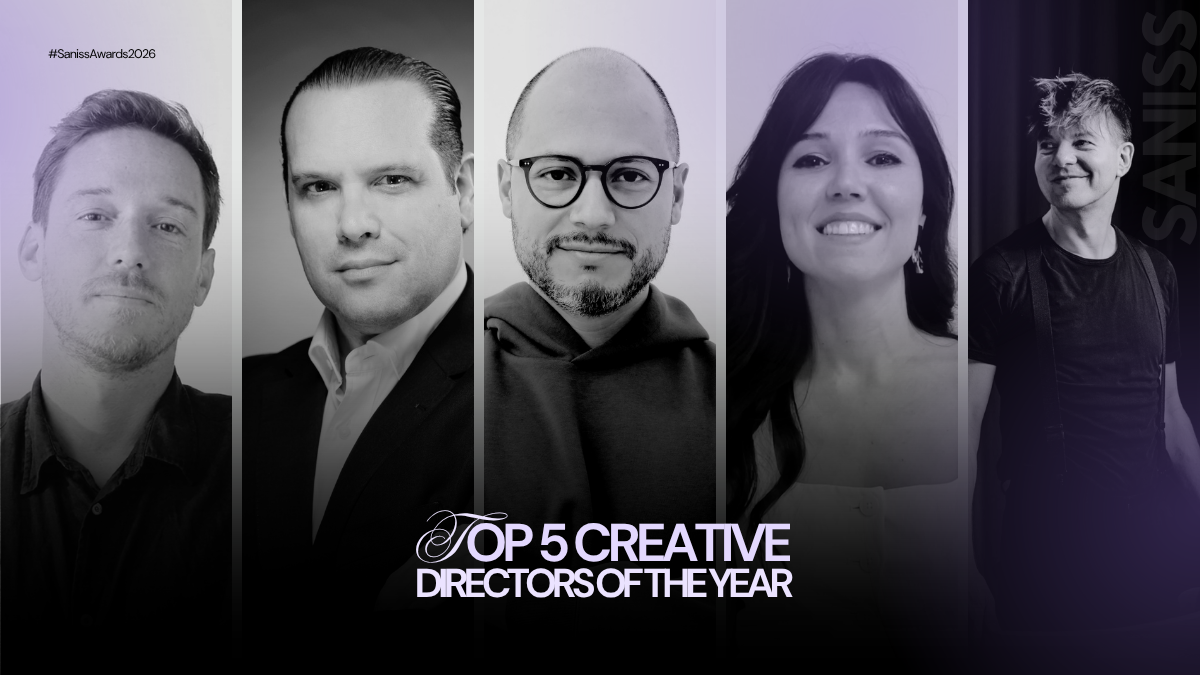
The top five international creative directors recognized at the 2026 Saniss Awards shared their secrets to developing successful health campaigns with us. While they all gave different answers, they all agreed on one point: The most relevant creativity comes from understanding people.
In one-on-one conversations, Davor Bruketa, Judith Cebrián de Pedro, Nico Smith, Rodolfo Borrel and Sebastián May shared their creative processes, the challenges they’ve encountered with health & wellness communications, and the habits that help them come up with creative ideas.
Tip #1: Give the mind enough space for unexpected connections.
According to Bruketa, creative director for Bruketa&Žinić&Grey, inspiration is not pursued, but comes when the mind has the freedom to connect ideas.
“Once I have absorbed a brief, I try to let it go and I allow it to remain in the back of my mind. Before going to sleep, while walking, in the shower or during a conversation, that’s when ideas usually appear.”
His favorite creative ritual, swimming, also helps him find clarity: a moment that he defines as a mental reset for ideas in their simplest form.
A similar view is shared by Nico Smith, of Grey Health New York, who explains that:
“Inspiration rarely comes from one place. I always look beyond advertising, in disciplines that constantly reinvent themselves: technology, music, art, independent cinema and cultural movements that shape the way people think and behave.”
Smith states that in the field of health, the most interesting ideas tend to arise where scientific rigor meets cultural relevance.
Beyond creative talent, all interviewees agree that understanding people is the real differential for a campaign.
Nico Smith advises those who want to stand out in the industry to start each project by understanding the target consumer audience first.
Judith Cebrián de Pedro, Executive Creative Director of Grow, agrees, adding that before sitting in front of a brief there is one indispensable step: living as many experiences as possible.
“It is very important point for me to fill the head with references, stories, experiences, conversations over some beers, songs, books, trips… That becomes the creative material for future ideas.”
Therefore, for her, a good creative is one who knows how to live in the world, away from screens and with ample social empathy. Their agency operates based on creative consciousness: where ideas must have a positive impact on both people and society.
Now, communicating about health issues involves translating complex information into messages that connect with people. In the case of Judith Cebrián, he mentions that the challenge lies in converting a large amount of data into memories with an emotional connection.
Rodolfo Borrel, says he had to break a societal taboo first:
“To get people to educate themselves, observe, and act on the color of their stool without feel embarrassed or alarmed, nor sensationalizing the issue. We had to turn an intimate issue into an acceptable and repeatable intervention at the right moment, redesigning an everyday object (toilet paper) into an educational tool”
For Borrel, a relevant idea in health must combine scientific evidence, usefulness, cultural sensitivity, and the ability to generate measurable impact.
Sebastián May said that writing is his creative ritual, and made it clear that the best ideas have the simplest origins: conversations. Which leads us to back to the main takeaway: creativity arises when people are understood.
These five creative directors lead us to conclude that it is empathy, observation skills, and the ability to transform complex problems into transformative ideas that really determines the success for a health campaign.